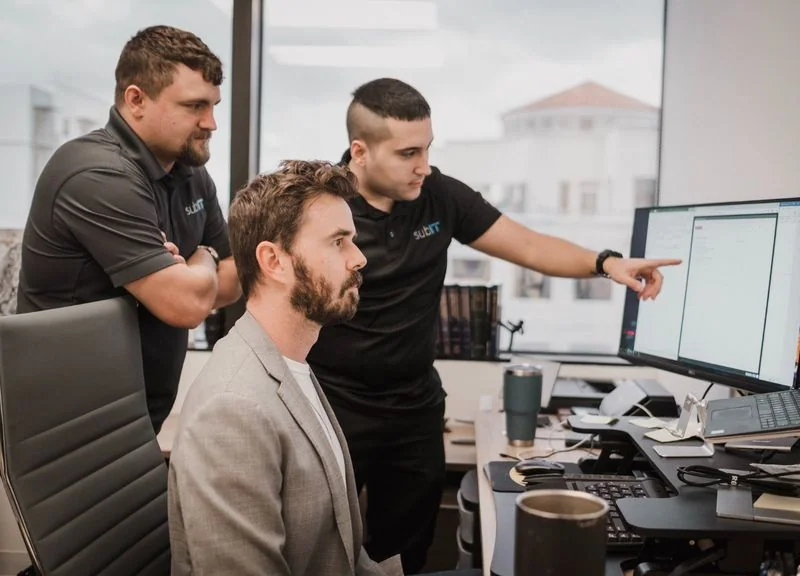

At SubIT Managed IT Services & Support, we offer nationwide vCIO services.
Since October 2015 we have served as the outsourced IT leadership for Florida companies and businesses across every U.S. time zone, with a 96%+ customer satisfaction score measured after every ticket.
A vCIO, or virtual Chief Information Officer, is a fractional IT director who owns your technology strategy without sitting on your payroll. That means a written technology roadmap, a real IT budget, vendor contracts someone is actually negotiating, and a security posture you can explain to a customer or an auditor.
A vCIO works alongside your current IT provider or our own managed IT services team, so you are not firing anyone to get a plan.
You work with the same people month after month, because our technician turnover is unusually low and they already know your business.
What Our Clients Say SubIT
“Felt like having a dedicated chief strategist on board.” Briana M.
That is the role a fractional CIO fills: someone accountable for the technology plan, not just the tickets.
“They took the time to understand our business requirements and provided tailored solutions.” Kristine S.
Strategy starts with how the business actually runs, not a preloaded vendor bundle.
“Their responsiveness is outstanding. Avoiding downtime is critical to our business, and they make sure we never have to face it.” Scott
Strategic planning only counts if the day to day stays stable while you build.
“Very knowledgeable managing our network, cloud backups, new equipment, and cybersecurity.” Daniel M.
One point of accountability across every system, instead of four vendors pointing at each other.
Why Work With SubIT Managed IT Services & Support
A satisfaction score you can actually check
SubIT measures customer satisfaction after every closed ticket and keeps that 96%+ CSAT score publicly displayed. It is a live benchmark, not a line in a sales deck.
Security built into every recommendation
Cybersecurity is not a separate add-on here. Prevention, monitoring, and written policy get folded into the technology plan, so a client can answer a security questionnaire without scrambling.
The same people, year after year
Low technician turnover means you work with people who already know your systems, your vendors, and your history. Nothing gets re-explained from scratch every quarter.
Coverage that scales past your next hire
SubIT supports companies with hundreds of employees across multiple locations and all U.S. time zones, and remote delivery is standard, not a workaround.
A department extension, not a transactional vendor
SubIT plugs in as your IT team rather than a ticket queue, coordinating vendors and budgets alongside a full IT services portfolio that covers support, security, and infrastructure.
What Size Company Actually Benefits From VCIO Services?
Most companies that get real value from a vCIO have between 10 and 200 employees, with the sweet spot at 10 to 75. At that size you have genuine technology complexity, multiple vendors, and compliance questions, but a full-time CIO salary and benefits do not make sense yet.
Fast-growing professional services firms, healthcare practices, construction and trade companies, and nonprofits are the most common fit. Larger organizations sometimes bring in a vCIO to give an existing IT team the senior strategic experience it lacks.
Size matters less than the symptom. If technology spending happens reactively, no one tracks when equipment reaches end of life, and staff are buying software the company does not know about, you are already paying for the absence of a roadmap.
According to McKinsey & Company, companies that align IT investments with business strategy are 2.5 times more likely to be top performers in their industries.
A vCIO engagement addresses that through quarterly business reviews, asset lifecycle tracking, and a budget that separates one-time purchases from recurring costs. Security sits at the center of that plan, which is why SubIT builds every roadmap alongside its cybersecurity services rather than treating protection as a separate line item.
Our vCIO Services
- IT strategic planning
- Multi-year technology plan
- IT budget development
- Help desk services
- Vendor contract management
- IT risk assessment
- Compliance gap analysis
- Quarterly business reviews
- IT governance framework implementation
- Cybersecurity policy oversight
- Asset lifecycle management
How Do I Know If My Current IT Setup Actually Needs A vCIO
If nobody at your company owns the technology budget, the answer is usually yes. Clear signals, like you buy hardware and software reactively instead of on a plan, you cannot say when your servers or laptops are due for replacement, and your IT vendor only appears after something breaks.
There is also a leadership-level version of the same problem. Your team cannot explain what technology actually costs or what risk it carries, a client or insurer asked for a written security policy you did not have, or a near-miss incident caught everyone off guard. Those gaps do not get solved by faster ticket response.
A vCIO owns strategy, budget, vendor accountability, policy documentation, and readiness against frameworks like NIST CSF and SOC 2. Helpdesk tickets, password resets, and break/fix work stay with your MSP or internal staff.
SubIT does both, but they are separate jobs. Where regulation is involved, our IT compliance services handle the operational side of HIPAA and audit readiness.
According to ISACA, organizations with strong IT governance report 25% higher returns on IT investments than those without it. If you are unsure where you stand, a technology assessment tells you before you commit to anything ongoing.
Can A vCIO Help Us With Cybersecurity Planning, Or Is That A Separate Service?
Cybersecurity planning is part of the vCIO engagement, not a separate add-on. It is usually the first thing we document, because most growing companies have security spending but no security plan tying it together.
A vCIO handles the strategy side: a written risk assessment, a risk register that tracks what could actually hurt the business, a compliance gap analysis, and vendor risk review of the outside tools touching your data. Your MSP or internal team still installs and manages the security tools. The vCIO decides what gets funded first and why.
Compliance is where this gets concrete. Florida businesses face breach notification duties under Fla. Stat. 501.171, healthcare clients face HIPAA, and anyone taking cards falls under PCI-DSS. Contract work increasingly means SOC 2 or CMMC questionnaires from larger clients. We map which ones apply to you and what evidence you need.
According to the IBM Cost of a Data Breach Report 2024, the average U.S. data breach cost $9.36 million in 2024, the highest of any country.
Security decisions also shape the rest of the roadmap, including how data is stored and backed up across your cloud infrastructure and which platforms are safe to consolidate onto.
About SubIT Managed IT Services & Support
SubIT Managed IT Services & Support has been building long-term IT partnerships since October 2015, working from Florida and supporting clients nationwide. The model is to act as a true extension of a company’s internal IT department, so businesses get enterprise-level support, cybersecurity, and infrastructure management.
Quality is measured, not claimed. SubIT maintains a 96%+ customer satisfaction score gathered through post-ticket surveys and displayed publicly as a running benchmark.
The team works cybersecurity-first, prioritizing prevention, monitoring, and protection across every environment. It supports organizations with hundreds of employees across multiple locations and all U.S. time zones.
Technician turnover stays exceptionally low, driven by company culture, ongoing training, paid certifications, and performance bonuses. For clients, that means working with the same people year after year, people who already know how your business runs.
Our Process for vCIO Implementation
1. Discovery Call And Current-State Assessment
We start with a conversation about where the business is headed and what technology is getting in the way. Then we document what you actually have running, like systems, vendors, licenses, and who touches what.
2. Technology Audit And Risk Register
Every system gets reviewed for age, cost, security exposure, and overlap with something else you are already paying for. The result is a written risk list, ranked by what could actually hurt the business first.
3. Multi-Year Strategy And IT Budget
You get a technology plan tied to your growth plans, whether that means new hires, new locations, or a platform change, with spending mapped out by quarter. No more surprise capital requests in the middle of a busy season.
4. Vendor And Contract Review
We pull every technology contract into one place, flag auto-renewals and duplicate tools, and handle the vendor conversations from there. That is one less set of calls on your calendar.
5. Quarterly Business Reviews And Reporting
Every quarter we review ticket trends, project status, spend against budget, and progress on the roadmap. Same people every time, so nobody re-learns your business.
6. Ongoing Policy, Governance, And Compliance Monitoring
We maintain written security and technology policies you can hand to a client, an auditor, or an insurance carrier. Requirements like HIPAA and PCI-DSS get tracked as they change, not after an audit question lands.
7. Strategic Adjustment As The Business Changes
When you add headcount, open a location, or a new regulation arrives, the roadmap gets revised rather than ignored.
Frequently Asked Questions About VCIO Services
What Does A VCIO Actually Do That Our Current IT Vendor Does Not Do?
A vCIO, sometimes called a fractional CIO or outsourced IT director, owns the decisions your IT vendor is not paid to make: the technology roadmap, the budget, vendor contracts, and your security priorities. Your current vendor fixes what breaks. A vCIO decides what you should buy, replace, retire, or renegotiate over the next 12 to 36 months.
How Much Does A Fractional VCIO Cost Compared To Hiring A Full-Time CIO?
A full-time chief information officer typically commands a six-figure salary plus benefits. A fractional engagement costs a fraction of that because you buy the leadership hours you actually need. Cost varies with company size, number of locations, compliance requirements, and how many vendor contracts need managing.
Can SubIT Act As Our VCIO If We Already Have An MSP We Are Happy With?
Yes. SubIT can sit above your existing managed service provider as the strategy layer, holding that vendor accountable to service levels and reviewing their invoices and recommendations on your behalf. You keep the helpdesk you like and gain someone whose job is representing your interests.
Are We Too Small For VCIO Services At Around 30 Employees?
No. Companies with roughly 10 to 75 employees are the clearest fit, because they are large enough to have real technology risk but too small to justify a full-time executive. Below that range, the decisions are usually simple enough to handle project by project.
How Often Does A VCIO Actually Meet With Our Leadership Team?
Most engagements run on quarterly business reviews with leadership, plus monthly or as-needed working sessions when a decision is live. Between meetings, SubIT stays involved in vendor negotiations, budget questions, and security issues instead of handing over a report and disappearing.
How Does A VCIO Handle Cybersecurity And Compliance Requirements Like HIPAA Or PCI-DSS?
It starts with a written risk assessment and a gap analysis against the standards that apply to you, whether that is HIPAA for health information, PCI-DSS for card payments, or a state data privacy law. From there you get a documented security policy, a prioritized remediation plan, and something you can hand to a client or auditor who asks.
Does Bringing In A VCIO Mean Replacing Our Internal IT Person?
No. An internal technician handles day-to-day support, a vCIO handles planning, budgeting, and vendor accountability. Most owners find the internal person works better once someone else is setting direction.
Does Remote VCIO Delivery Actually Work, Or Do We Need Someone Local?
Remote delivery is standard, and SubIT supports clients across every U.S. time zone and multiple locations. Strategy work happens in review meetings, documentation, and vendor calls, none of which require being in the room. SubIT’s 96%+ customer satisfaction score, measured after every ticket, holds across remote clients.
How Does A VCIO Engagement Change As Our Headcount Grows?
The scope expands with you: more locations, more compliance exposure, more vendors to manage, and a longer planning horizon. Because SubIT has low technician turnover, you keep working with people who already know your environment instead of re-explaining your business to a new team every year.
Start Your VCIO Engagement With SubIT Managed IT Services & Support
If technology decisions keep landing on your desk and your current IT vendor only shows up after something breaks, a 30-minute IT strategy call is the fastest way to change that. No obligation, no technical prep required.
You describe what is frustrating you, and SubIT tells you plainly whether outsourced IT leadership fits your business.
Most engagements begin within days. SubIT works as an extension of your team, whether you keep your existing managed service provider for day-to-day support or not, and delivers nationwide across every U.S. time zone.
Book your free IT strategy call and walk away with a clear read on your technology roadmap, your vendor situation, and your cybersecurity posture.