The era of “cloud-first” has evolved into something far more nuanced: “cloud-smart.” For IT decision-makers, the question is no longer whether to migrate, but how to orchestrate a sprawling ecosystem of on-premise infrastructure, private clouds, and multiple public cloud providers.
If your organization feels like it stumbled into a multi-cloud environment by accident rather than by design, you aren’t alone. Shadow IT, mergers, and department-specific tool selection often create a fragmented environment before a central strategy is formed.
Yet, when created intentionally, this environment becomes your greatest asset, offering resilience, cost leverage, and technological agility.
At SubIT, we believe that your infrastructure should be an engine for revenue, not a bottleneck. We’ll help you understand design, implementation, and management of hybrid and multi-cloud environments, helping you move from reactive maintenance to proactive architectural dominance.
Understanding the Difference Between Hybrid vs. Multi-Cloud
To design the right architecture, we must first distinguish the terminology, as they require distinct management approaches.
Hybrid Cloud
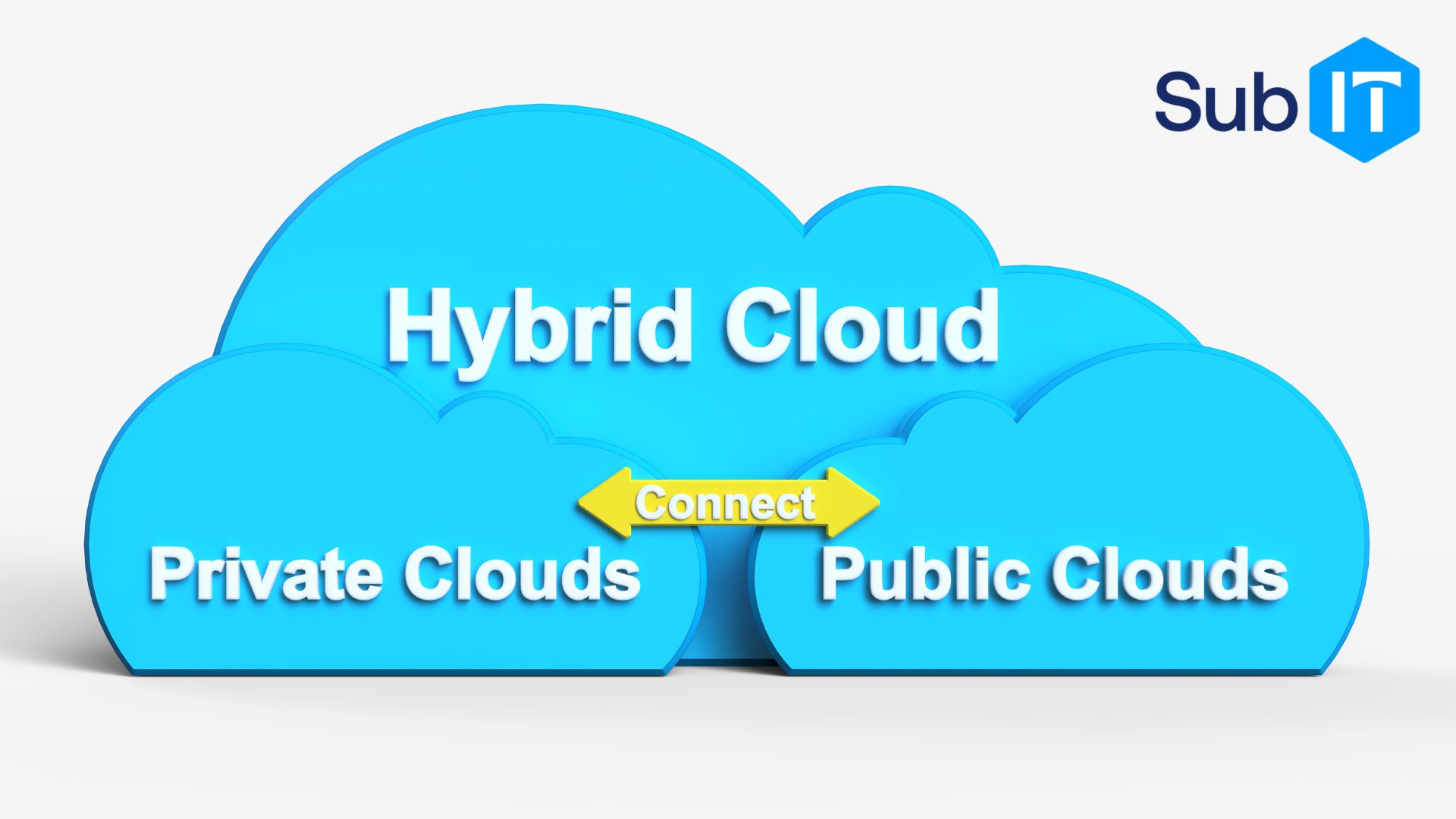
This architecture connects a private cloud (or on-premise infrastructure) with a public cloud. The defining feature is interoperability. Data and applications must be portable between the two.
This is best for regulatory compliance (keeping data on-prem), low-latency requirements, and legacy application modernization.
Multi-Cloud
This involves using two or more public cloud providers (e.g., AWS and Azure) simultaneously.
This is best for avoiding vendor lock-in, accessing “best-of-breed” services (e.g., using Microsoft for productivity apps and Google for analytics), and high-availability disaster recovery.
The Convergence
In reality, most mature organizations end up with a Hybrid Multi-Cloud architecture. They maintain on-premise roots for core systems while leveraging multiple public clouds for edge computing and SaaS applications.
The State of Hybrid and Multi-Cloud in 2024
The monolithic cloud deployment is dead. We are operating in a heterogeneous world.
According to recent industry data, 73% of organizations have adopted a hybrid cloud strategy, blending public cloud flexibility with private cloud control. Even more telling is that 92% of organizations now utilize a multi-cloud strategy, relying on more than one public cloud provider (such as combining AWS for compute with Google Cloud for AI).
This shift isn’t just about redundancy:
- Innovation: 66% of enterprises prioritize generative AI as a top use case for hybrid/multi-cloud architectures.
- Security: 59% of tech leaders leverage these environments to segment sensitive data from public-facing applications.
- Economics: 39% of businesses deploy these models specifically to arbitrate costs and avoid vendor lock-in.
However, great flexibility brings great intricacy. Without a unified management strategy, these environments can lead to “visibility gaps,” spiraling egress costs, and security vulnerabilities.
How to Design Your Structure
A clear architecture is built on decisions regarding workload placement and connectivity.
1. Workload Placement Strategy
Not every application belongs in the public cloud. A proper assessment involves categorizing workloads based on volatility and sensitivity.
- Static Workloads: Predictable, sensitive internal applications often offer better price-performance ratios in a private cloud or colocation environment.
- Dynamic Workloads: Applications with bursting traffic (e.g., e-commerce during holidays) belong in the public cloud to leverage auto-scaling.
- AI & Data Workloads: With 66% of enterprises eyeing AI, a common pattern is “training” models in the public cloud (accessing massive GPU clusters) while “inferencing” (running) them on-premise to protect intellectual property.
2. Networking and Connectivity
The lifeline of any hybrid architecture is the network. If your public and private clouds cannot communicate efficiently, latency will kill user experience.
- VPN vs. Direct Interconnects: While VPNs are cost-effective for smaller workloads, enterprise architecture demands dedicated connections (like AWS Direct Connect or Azure ExpressRoute) to guarantee throughput and security.
- Data Gravity: Data is heavy. Moving terabytes between clouds incurs significant “egress fees.” Architect your applications so that the computer moves to the data, rather than moving data to the computer.
3. Security and Governance
Security in a hybrid environment leverages the Shared Responsibility Model. While the vendor protects the cloud, you must protect what is in the cloud.
- Identity Management: Implement a centralized Identity and Access Management (IAM) solution that spans all environments. You cannot afford to manage separate user directories for AWS, Azure, and your local servers.
- Zero Trust: Assume a breach can happen anywhere. Micro-segmentation prevents lateral movement from a compromised public web server to your internal database.
Managing the Sprawl: Tools and Strategies
The biggest risk in multi-cloud architecture is operational fragmentation, having three different teams managing three different clouds with no unified view.
Unified Observability
You cannot manage what you cannot see. “Swivel-chair” management (logging into multiple portals to check health) is inefficient and dangerous.
Aim for unified management platforms that ingest metrics from on-premise servers and public cloud instances simultaneously. This allows you to correlate a slow database query on-prem with a latency spike in the cloud.
Cost Control (FinOps)
Cloud waste is a silent budget killer. In multi-cloud setups, it’s easy to lose track of “zombie” instances, servers that are running but not utilized.
Enforce strict tagging strategies. Every resource must be tagged with a cost center, owner, and environment (Prod/Dev).
Use policy-as-code to automatically shut down development environments after business hours or resize over-provisioned instances.
The Future of AI and Edge Computing
The architecture you design today must support the technologies of tomorrow. As AI adoption grows, we are seeing a shift toward Edge Computing, processing data closer to where it is created (the “edge”) rather than sending it all back to a central cloud.
This aligns perfectly with SubIT’s mission. Just as we integrate smoothly with client teams to align IT strategies with business goals, your infrastructure must integrate edge, private, and public resources to support real-time decision-making. The future is distributed, and your architecture must be ready.
Turning Confusion into Competitive Advantage
The move to hybrid and multi-cloud architecture is the maturation of the IT industry. It offers the resilience to survive outages, the flexibility to innovate with AI, and the leverage to control costs.
However, success requires more than just signing up for AWS and Azure. It requires a deliberate architectural mindset that prioritizes visibility, security, and strategic workload placement.
At SubIT, we help you architect it for growth. Whether you need a partner to manage the day-to-day of your hybrid environment or an advisor to guide your digital transformation, we are the IT department you’ve always wanted.
Ready to gain control of your cloud infrastructure? Contact SubIT today for a comprehensive architectural assessment.